

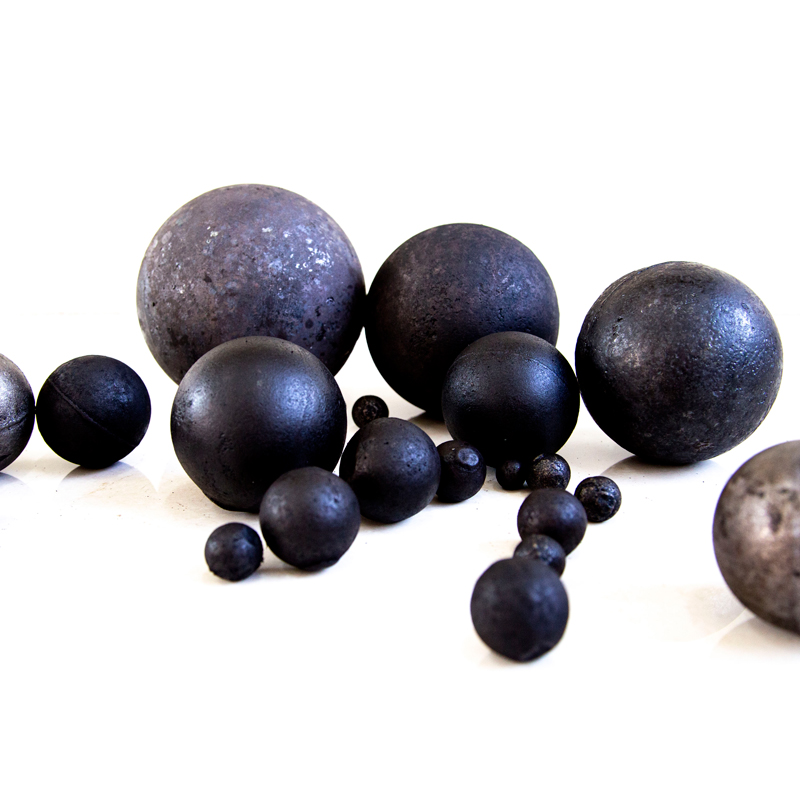
High chrome grinding balls are essential grinding media for ball mills. Their quality directly affects grinding efficiency, production cost, and service life. For purchasing managers and mining engineers, knowing how to judge the quality of high chrome grinding balls is crucial. This article explains five key inspection indicators to help you scientifically evaluate the quality of high chrome grinding balls and make cost-effective decisions.
ball mill media suppliers
1. Hardness
Hardness is one of the most critical indicators of high chrome grinding balls as it determines wear rate and service life.
-
Standard range: 58–66 HRC
-
Low hardness → fast wear, higher cost
-
Excessive hardness → prone to cracking under high impact
Testing method: Measure hardness at different points on the ball using a Rockwell or Brinell hardness tester to ensure uniformity.
2. Chemical Composition
The wear resistance of high chrome grinding balls depends on the chromium content and other alloying elements such as carbon, manganese, and silicon.
-
Chromium content: 10%–30%
-
Low chromium → fast wear
-
High carbon → reduced toughness, easy cracking
Testing method: Use spectrometer or chemical analysis to verify composition and batch consistency.
3. Impact Resistance
Impact resistance determines whether the grinding ball can withstand coarse grinding or high-load conditions without breaking.
-
High-quality high chrome balls combine hardness with sufficient toughness
-
Poor impact resistance → prone to cracking, increasing replacement frequency
Testing method: Conduct drop tests or Charpy impact tests to see if balls crack under standard conditions.
4. Breakage Rate
Breakage rate is an important indicator of durability.
-
High-quality high chrome balls usually have a breakage rate ≤1%
-
High breakage → increases operational cost and may damage mill liners
Testing method: Sample balls are ground in a small test ball mill for a set period, and the percentage of broken balls is calculated. Compare with supplier test reports.
5. Surface Finish and Size Tolerance
The surface quality and size precision affect grinding efficiency and mill stability.
-
Smooth surface, free of cracks and pores → uniform wear
-
Large size deviation → uneven ball motion, reduced efficiency
Testing method: Measure diameter tolerance (generally ±0.5 mm) with calipers or laser measurement tools and inspect surface visually.
6. Summary of Five Key Quality Indicators
| Indicator | Description | Testing Method |
| Hardness | Determines wear rate and service life | Rockwell/Brinell tester |
| Chemical Composition | Chromium and alloy content | Spectrometer / chemical analysis |
| Impact Resistance | Prevents cracking under impact | Drop test / Charpy test |
| Breakage Rate | Ensures operational safety | Small-scale ball mill test |
| Surface Finish & Size | Affects grinding efficiency and stability | Calipers/laser measurement + visual inspection |
Why Choose High-Quality High Chrome Grinding Balls?
-
Low wear → reduces production cost
-
Low breakage rate → less downtime and maintenance
-
Stable hardness → improves grinding efficiency
-
Precise size → ensures smooth mill operation
Scientific selection and inspection of high chrome grinding balls can significantly increase mill output and efficiency.
Our Advantages
We specialize in producing high chrome grinding balls using:
-
Fully automated casting production lines
-
Precision heat treatment processes
-
Strict quality control systems
Every batch of our balls is guaranteed to be:
-
Uniform in hardness, excellent wear resistance
-
Low breakage rate, strong impact resistance
-
Precise in size, smooth surface finish
Contact us today to request free samples and technical selection guidance for the optimal grinding media solution.